

What People Say, What They Vote For, What They Do
Releasy Suite
Surveys capture what people say, the least reliable evidence there is. Indie Polls now bundles with Upvoted and Hookfire to show what they do.
The oldest problem in survey research
Ask a hundred people whether they would pay for a feature and a comfortable number will say yes.
Ship it, and watch what happens.
This gap has a name in research, and every founder who has run a survey has felt it without knowing the term. Stated preference is what people report when asked. Revealed preference is what they do when it costs them something. They are not the same measurement, and the distance between them is not dishonesty. People answering your survey are being sincere. They are just predicting their own future behaviour, and humans are famously mediocre at that.
Surveys are still the right tool, for a reason nothing else replaces: they are the only instrument that gives you why. Analytics tells you that forty percent of users abandon the second onboarding step. Only a question tells you it is because the copy implies a credit card is required when it is not.
So the answer is not to stop asking. It is to stop treating an answer as the end of the enquiry.
Three measurements of the same question
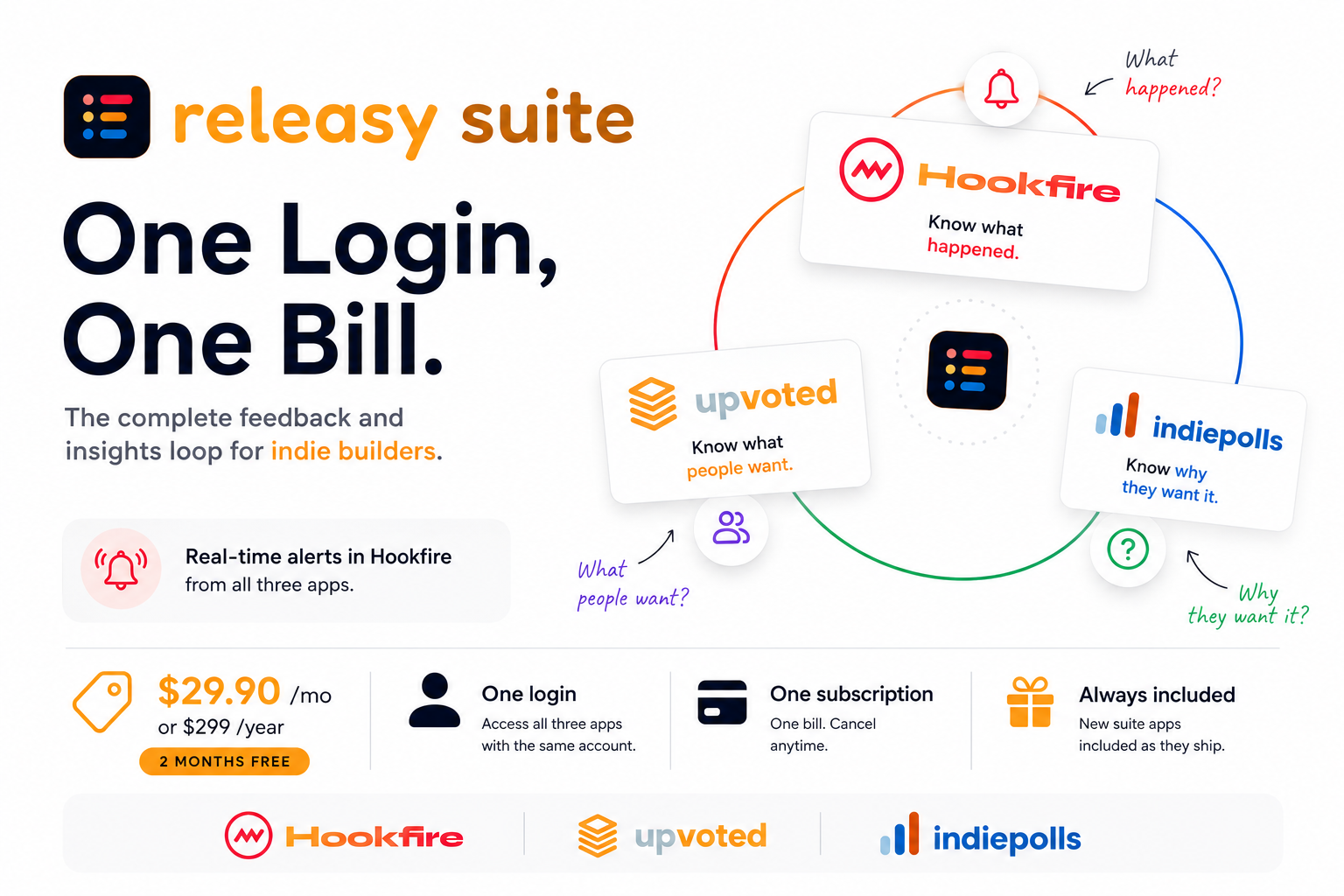
Indie Polls is now part of the Releasy Suite, bundled with two products that measure the other two thirds.
Upvoted is a feature voting board. Users post what they want, and other users vote. That is not quite revealed preference, because a vote is cheap, but it is meaningfully more expensive than answering a survey. Someone has to care enough to find your board, read a request, and press a button with their name attached. Votes accumulate over weeks from people you did not prompt, which makes them free of the selection effect that shapes every survey you send.
Hookfire turns webhooks into push notifications on your phone, from more than thirty sources including Stripe, GitHub, Sentry, and Intercom. This is where actual behaviour lives. Not what someone said they would pay, and not what they voted for, but the payment that fired. Indie Polls is itself one of Hookfire’s sources, so a completed survey response can land on your lock screen the moment it arrives.
Lined up, the three instruments answer three different questions about the same feature:
- Indie Polls: what do people say? Rich, explanatory, fast to collect, weakest as prediction.
- Upvoted: what do people vote for? Ranked, unprompted, accumulated over time.
- Hookfire: what did people do? Unambiguous, unarguable, and always after the fact.
Each one is weak exactly where the next is strong. That is the case for having all three rather than a favourite.
Triangulation in practice
Say you are considering a paid team tier.
You start with a survey, because it is the cheapest and most informative first move. Embed it on your pricing page, targeted to that URL so you are asking people who are already thinking about money. Ask what stops them upgrading, what a team plan would need to include, and roughly what they would expect it to cost. Ten minutes of setup with AI drafting the questions, and answers start arriving the same day.
The survey comes back saying people want shared workspaces and would pay somewhere around twenty dollars a seat.
Now check that against your Upvoted board. If shared workspaces have been sitting at three votes for eight months while an export feature nobody mentioned in the survey has ninety, you have learned something important: your survey respondents were a different population from your engaged users, and one of those two groups is telling you what to build.
Then, whichever way you go, Hookfire is the instrument that closes it. When the tier ships, subscription events hit your phone in real time. That is the number that settles the argument, and it is the only one of the three that cannot be talked out of.
None of this is a criticism of asking. It is what asking is for: forming a hypothesis good enough to be worth testing, quickly and cheaply, before you spend a month building.
What the bundle includes
One subscription covers all three products.
One login. Buy the suite in any of the three apps and the other two unlock for the same email address. No second registration, no new password. Each app has a switcher in its header, a small grid icon, and clicking through signs you in on the other side.
One bill. A single monthly charge covering all three, instead of three subscriptions with three renewal dates.
Every app unlocked. Full top tier on each one. For Indie Polls, that is unlimited surveys, unlimited responses, AI generation, templates, CSV export, API access, the embeddable widget, Slack, custom webhooks, and hosted page branding. New suite apps are included as they ship.
One point to be clear about: each product keeps its own account and its own data. There is no shared workspace across all three. What moves between the apps is your identity and your subscription, not your projects.
Pricing
The Releasy Suite is $29.90 a month, or $299 a year, which works out to two months free.
Each product’s top tier is $14.90 a month individually. Three of those is $44.70, so the bundle costs less than two of them.
Every plan starts with a 7 day free trial, no credit card required. Cancel in a click if it is not for you.
Where to start
If you already run surveys with Indie Polls, nothing changes. Your surveys, targeting, widget, and integrations work exactly as before.
What is new is the switcher in your header. The most useful first experiment is a small one: take the finding from your most recent survey, the one you were not completely sure about, and put it on an Upvoted board as a feature request. Then wait. Votes from people you did not prompt are a very different kind of evidence from answers you asked for, and the two together are worth considerably more than either alone.
Ask better questions. Then go and check the answers.
 Steve M.
Company
Product
Developers
Resources
Legal
Other apps from Releasy

Build a community where users provide feedback, vote, and discuss the product features that truly matter to them. Request features from anywhere with the one line embeddable widget.

The headless API first Issue Tracker. Report issues from anywhere, share them with anyone. Supabugs is the fastest and simplest platform to report, track, and resolve issues.

A text RPG of private descents. AI generates a fresh dungeon in real time every playthrough, shaped by your choices and never repeated.

Connect Stripe, Shopify, PayPal, GitHub and 10+ other platforms. Get instant push notifications on your phone when payments land, orders ship, or subscriptions cancel.

Try Releasy, the hassle-free test management platform and issue tracker for agile teams. Releasy allows your clients, even those without a technical background to test, validate, and accept project releases with ease.